
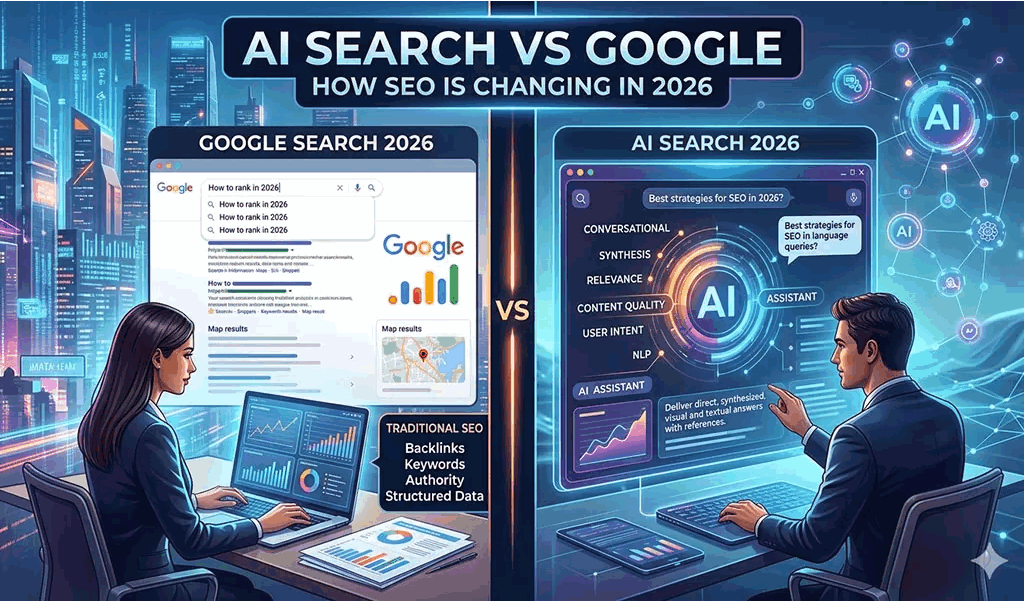
Listen to the Audio presentation of this article
In my career developing large, transformational data ecosystems and associated search engines, including the design of Caselaw NSW, I have lived and breathed the mechanics of how we find information.
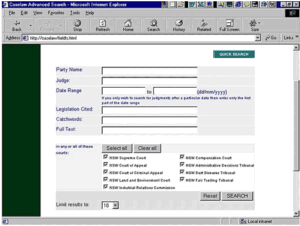
I still remember like it was yesterday the directions of the then Chief-Justice of the NSW Supreme Court, Justice James Spigelman, who asked for an Austlii (a predecessor to Judicial Search from the NSW University of Technology) on Steroids.
To achieve such a feat, we needed to start from scratch, analyze the data components across all NSW Court and Tribunal decisions, and harmonise all the key indexes in order to be seamlessly searched and retrieved from the one search page, by the legal profession and just as importantly, by the public.

In consultation with the various project stakeholders, including Judges, Magistrates, Tribunal Members, Associates, Court/Tribunal back-room staff and the NSW Law Society, we developed the Justice Sector Meta Data Standard, which became the blue-print for embedding Meta Data into Judicial Decisions for publications across Australia, for the purposes of publication, search and retrieve.
For decades, building these systems meant creating highly sophisticated digital filing cabinets.
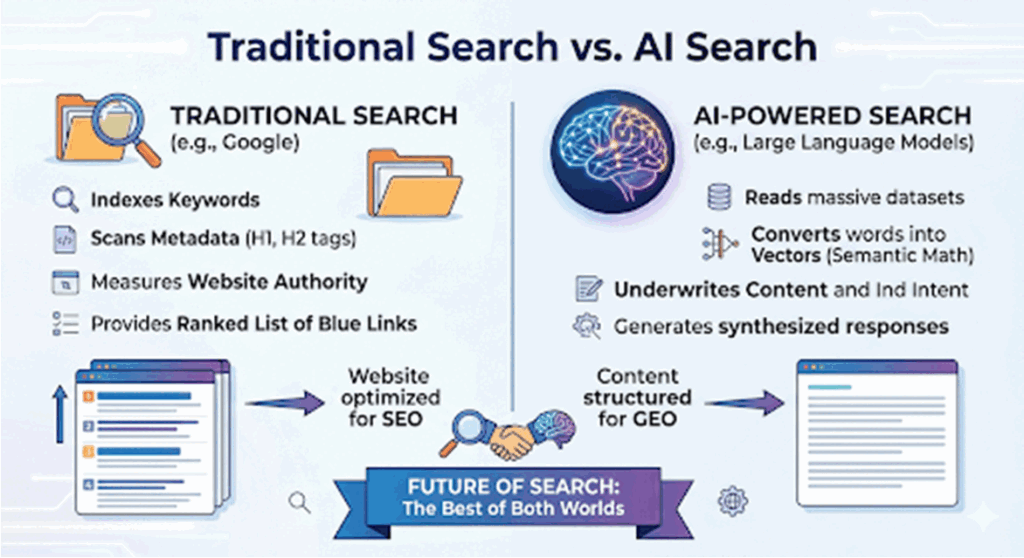
We designed search spiders to index the data, scan for keywords, metadata and image descriptions, and in the cases of search behemoths like Google, page authority and popularity.
When you typed a query, the system matched your words against that index and handed you a ranked list of links. It was an incredibly powerful tool that provided the user a list of relevant documents associated with the search terms.
This framework gave birth to SEO (Search Engine Optimization), the art and science of tweaking your website’s code, structure and keywords so traditional search engines would rank you at the top of those results.
It was only years later, while working on my dissertation for “Clinical Decision Making Algorithms in Advanced, Recalcitrant Renal Cell Carcinoma”, where I first encountered the concept of a “negative feedback loop”, which took a huge step away from the consistent and highly structured return of ranked search results based on Meta Data, and instead explored the concept of fluid responses via semantic algorithms that could learn and evolve by its usage.
As impressive as this sounds, these were only cursory observations on research that was still largely based on highly structured and normalized case studies from across the globe of relevant interventions in the treatment of a Renal Cell Carcinoma, which was up until then incurable in advanced form.
Despite this early insight, I could never have imagined that algorithms, or semantic math, would reach the incredible fluency of question versus answer that we have in current day LLM AI models.
Even though I have since undertaken numerous courses on generative AI Prompt Engineering amongst others, and as a result have been able to build customised AI Assistants with both AI coding and zero coding techniques, and ultimately moved towards AI workflow automation and Agenic AI, I still sometimes pause, take a step back and wonder whether I am experiencing an unusually lucid dream, or whether I am baring witness to a technology that is better described as “magic” rather than science.
However, despite my ongoing marvel at what we have achieved, AI-powered search is definitely real, it is shaping our lives today in ways we never thought possible, and it works not by magic, but by math.
So today, instead of searching for a keyword and being provided with a list of documents to read, we have a technology that talks to us directly, giving us fluent, synthesized answers to our questions.
But how does it leap from matching keywords to seemingly “thinking” and generating original paragraphs?
And what does SEO mean in a world without blue links?
Here is the plain-language breakdown of what is actually happening under the hood.
1. Traditional Search is a Librarian while AI is a Subject Matter Expert
Think of traditional search like a world-class librarian. If you ask for information on a topic, the librarian points you to the exact aisles, books and page numbers where those words appear.
You still however have to open the books and do the reading yourself. Traditional SEO is just making sure your book has a bright, clear cover so the librarian notices it.
But when you think of AI, this concept is no longer relevant. AI has instead read all the books in the library beforehand. When you ask it a question, it doesn’t point you to the bookshelf. It uses its retained knowledge to explain the answer to you in its own words.
2. The Secret Sauce: Transforming Words into Math
To understand how AI does this, we have to look at how it “reads.” Humans see letters; AI sees numbers. When AI is trained on massive datasets from the internet, it converts words into complex mathematical coordinates via algorithms.
In this mathematical space, words with similar meanings are placed close together. For instance, AI doesn’t just know the word “apple” as text; it knows that “apple” sits mathematically close to “fruit,” “pie,” and a “tech company.” This allows AI to understand the context and intent of your question, rather than just matching the literal words you typed.
3. The Power of “Prediction”
When AI generates a remarkably fluent response, it isn’t copying and pasting from a website it found. It is actually generating the response syllable by syllable, word by word, in real-time.
AI calculates the next word to follow the previous ones, based on the patterns it has determined from the enormous amount of online data it has already indexed.
It is essentially the world’s most advanced version of the predictive text you are often assisted with when typing text in a Search Engine, Word Document, Email Client or Mobile Phone contact list.
Predictive text applications anticipate the words or phrases a user intends to type based on their context and past behavior.
Because AI has analyzed billions of pages of human writing, it knows exactly how a knowledgeable human would structure a sentence, allowing it to sound fluent, direct and authoritative.
4. The New SEO: From “Ranking” to “Referencing”
So, what happens to SEO when users stop clicking links and just read the AI’s summary? It evolves into AIO (AI Optimization) or GEO (Generative Engine Optimization).
Traditional SEO was about helping your website rank high enough to get a click. AI optimization is about ensuring your content is clear, authoritative and structured so that the AI trusts it enough to cite it as a source inside its answer. Instead of stuffing keywords, modern optimization requires building deep “topical authority” and writing clear, direct answers that an AI can easily digest and repeat.
5. Why This Matters for the Future
Traditional search is still unbeatable when you need an absolute source of truth, a specific legal citation or a direct link to a primary document. But AI excels when you need analysis, synthesis or a complex concept broken down into simple terms.
As we move forward, the most powerful systems are marrying these two worlds, using traditional indexing to find the exact, verified facts and AI to explain them fluently.
Robert Savellis
Robert Savellis is a Senior Business Analyst/Data Specialist and Search Engineer with over 20 years’ experience delivering complex, high‑stakes digital systems across government, legal, healthcare, finance, and compliance sectors.
To find out more about my expertise, please explore the following links, and if you are interested in discussing my experience further, please feel free to contact me via my contact form.
- Robert Savellis Linkedin Profile
- Explore the over 140 Citations I have received to my work from both Academia and Professional publications
- To contact me or request a copy of my CV or Portfolio document, please use the following Contact Page.